Painting outdoor concrete: porches, patios and steps
Painting outdoor concrete looks like the quick fix for a tired porch or patio, and for a season or two it often is. But wet springs, freeze and thaw and road salt are hard on any coat that sits on top of a slab. Here's why paint peels outdoors, how to give it the best chance, and what lasts longer.
Updated
| Finish | Where it sits | What it looks like | How it wears |
|---|---|---|---|
| Paint | On top, as a film | Solid, even color | Peels and chips, often within a few years outdoors |
| Stain | Soaks into the surface | Translucent, natural, mottled | Fades slowly and is refreshed with a reseal |
| Tinted sealer | A thin coat on top | A light wash of color | Wears with the sealer, every two to four years |
| Stamped overlay | A new layer bonded on | A new pattern and color | Lasts like stamped concrete, with resealing |
Why paint peels on outdoor concrete
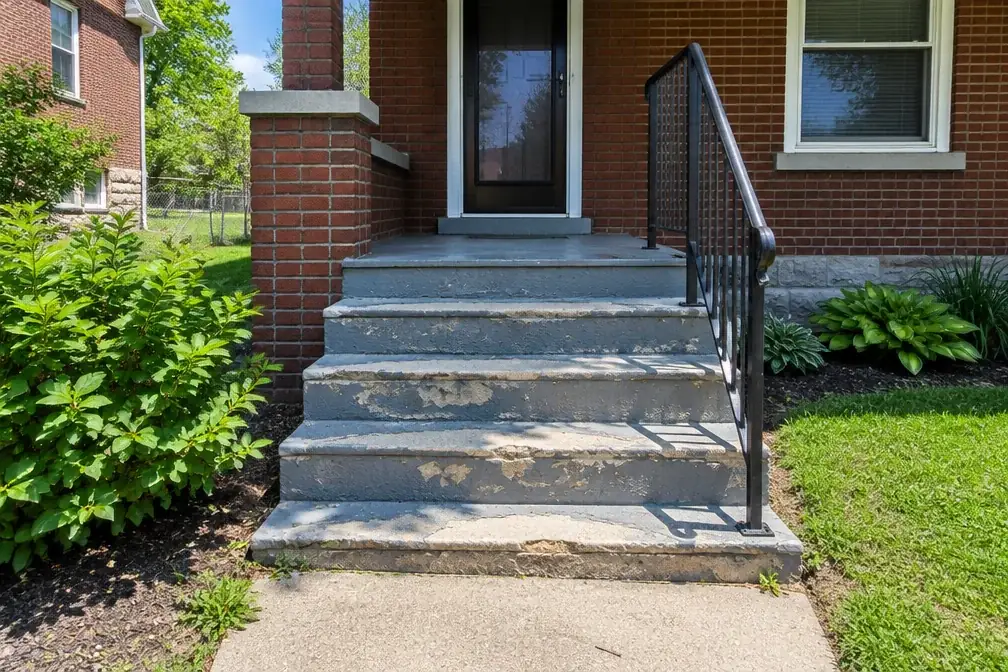
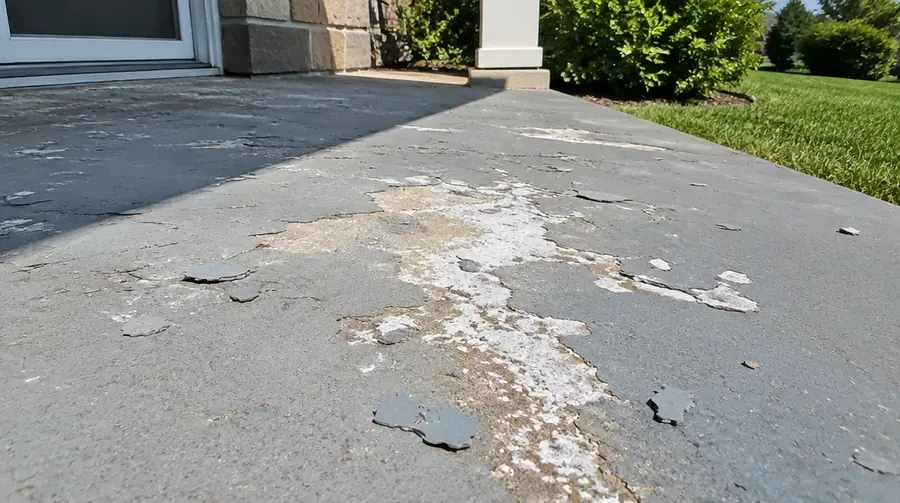
Concrete is never fully dry. It soaks up water from the ground and the rain, and that water tries to get out through the top of the slab. Paint forms a film over the surface, so the moisture pushes against it from below. On a slab that sits on soil, such as a patio, a walk or a porch built on a fill of earth, that pressure lifts the paint in blisters and flakes. White powder under the flakes is efflorescence, the salts the water carried up with it.
Freeze and thaw make it worse. Water caught under the paint freezes, expands and pries the film loose, and Pittsburgh goes through that cycle many times each winter. Add rock salt from the street and the scraping of a shovel, and most painted steps and walks look worn by their second spring.
There's a simple test you can do before you start. Tape a square of clear plastic to the slab on all four sides and leave it for a day. If the underside is wet or the concrete has darkened, moisture is coming up through the slab, and paint is likely to peel there no matter how well you prep.
Where paint works, and where it struggles
Paint does best where the concrete stays fairly dry and isn't walked on much. A covered porch floor under a roof, with a crawl space or open air under it, is the classic case, and that's where porch and floor enamels have been used for generations on older Pittsburgh houses. Vertical surfaces, such as a block foundation wall above grade, also hold paint better than flat ones.
Paint struggles anywhere water sits or salt lands. Uncovered patios, front steps facing the street, walks and pool decks all take a beating. Painting a concrete porch that is open to the sky is somewhere in between: it can work for a few years with good prep, but it will need scraping and recoating.
- Usually fine: covered porch floors, above-grade walls, garage steps under a roof
- Short-lived: open porches, patios on soil, front steps that get salted
- Avoid: pool decks, slabs that test wet, and any stamped concrete
Paint, stain, tinted sealer or overlay?
If the goal is new color on an outdoor slab, paint isn't the only option, and on most patios it isn't the best. A stain soaks into the concrete, so there's no film to peel, though it shows the slab underneath, patches and all. A tinted sealer adds a light wash of color and protection in one coat. An overlay bonds a new layer to a sound old slab and can be colored and stamped like new concrete.
As a guide, our concrete staining usually runs $3 to $7 per square foot with sealer, a clean and reseal $1.50 to $3, and a stamped concrete overlay $15 to $24. Paint costs less up front if you do it yourself, but count the scraping and repainting over the years before you compare.
If you do paint: the prep that decides how long it lasts
Most failures in painting outdoor concrete come from the prep, not the paint. Read the label on the can, as each product sets its own rules for temperature, primer and dry time, and follow it over any general advice. These are the steps that matter on almost every outdoor job.
- Run the plastic sheet test first, and stop if the slab tests wet
- Scrape off all loose paint, then clean with a degreaser and rinse well
- Remove sealer or curing compound, as paint will not bond to it
- Open up smooth concrete by etching or grinding, as the label directs
- Fill cracks and chips with a patch made for concrete, and let it cure
- Let the slab dry for several days of dry weather before you start
- Use a paint made for exterior concrete or porch floors, not wall paint
- Apply thin coats, and add an anti-slip grit to steps and walking areas
Painting stamped concrete
We'd steer you away from it. Paint fills the texture that makes the pattern look real, it covers the darker release color in the grooves, and it peels first in exactly those grooves, where water collects. A painted stamped patio usually looks worse after a couple of years than it did faded.
A faded stamped patio can almost always be brought back without paint. The surface is cleaned, failed sealer is stripped, the color is tinted back and a fresh sealer goes on, usually for $3 to $6 per square foot. See stamped concrete repair and restoration for how that works.
Getting paint off before a stain or overlay
Old paint is the main thing standing between many tired porches and a better finish. A stain can't soak through paint, so the old coats have to come off completely, usually by grinding or with a stripper made for concrete, and any traces left behind will show as blotches. Our guide to concrete stain colors covers testing a stain on an old slab.
An overlay needs a clean, open surface to bond to as well. Paint left under an overlay can let go and take the new layer with it, which is why the prep for an overlay starts with grinding the slab back to bare concrete. It's slow, dusty work, so ask for it to be listed in any quote.
Older Pittsburgh porches and the paint question
Many older city houses, from rowhouses with small front stoops to big homes with deep porches, have concrete that has been painted gray or red again and again over the years. Under a roof, those coats may still be holding. On the open steps in front, they're usually the part that's peeling, chipped by shovels and lifted by salt.
Before choosing a new coat, look at what's under the old ones. If the concrete is sound and the porch is covered, a careful repaint may be all it needs. If the steps are crumbling at the edges, the paint is the least of the problem, and the steps need repair first. Our page on stamped concrete steps and porches explains the options when an old porch needs more than color.
Common questions
Is painting outdoor concrete a good idea?
On a covered porch or a dry wall, it can be. On a patio, walk or steps open to the weather, paint tends to peel, and a stain or tinted sealer usually lasts longer.
Is painting a concrete porch a good idea?
If the porch is covered and the concrete is sound and dry, yes. An open porch can be painted too, but expect to scrape and recoat every few years.
How long does painted concrete last?
Outdoors, often only a few years, and less on steps that get salted. Covered porch floors with good prep last much longer.
Does painting concrete make it slippery?
It can, as paint fills the texture and leaves a smoother film. Mixing an anti-slip grit into the last coat helps on steps and walks.
Can stamped concrete be painted?
It can, but it's rarely a good idea. Paint hides the pattern and peels in the grooves. Cleaning, recoloring and resealing gives a better result.
Does painted concrete need to be sealed?
Not usually. Most concrete and porch paints are made to be the top coat. Check the label, as some systems add a clear coat.
More services
- stamped concrete
- stamped concrete patio
- concrete patio contractors
- stamped concrete walkway
- stamped concrete steps and porches
- stamped concrete pool deck
- stamped concrete overlay
- stamped concrete sealing
- stamped concrete repair
- concrete staining
- decorative concrete
- colored concrete
- decorative concrete driveway